Coordinate expert input
Combine business, AI, technology, industry and workforce perspectives with appropriate permissions.
Bring AI, business, technology, workforce and governance specialists together to shape organization-level assessments, recommendations, courses, and practical workshops.
AI readiness is cross-functional. A community can invite specialists who contribute perspectives, discuss trade-offs, co-create educational resources and support the organization through workshops.
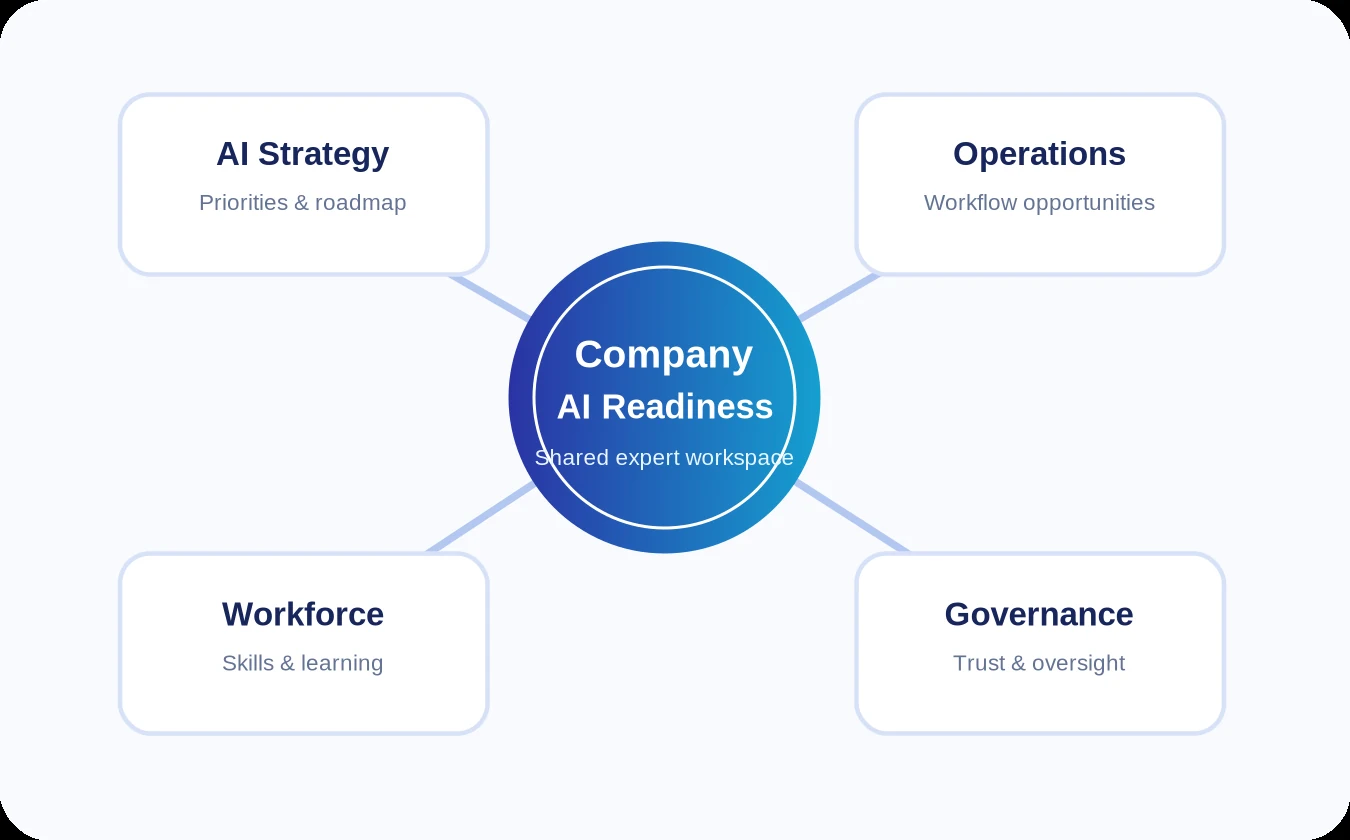 Collaboration model
Community-based subject experts can contribute to AI adoption assessments, then help turn approved recommendations into practical learning assets and follow-up workshops.
Combine business, AI, technology, industry and workforce perspectives with appropriate permissions.
Create reviewed courses and workshop material that support identified needs.
Where approved, publish expert-authored course pages with SEO/GEO readiness.
Provide continuing community sessions and opportunities to engage the expert team.
Use qualified human review. Confidential company assessment evidence must never be exposed as public course content.
See community programsAgree on business goals, boundaries and assessment questions.
Bring internal and external subject experts into defined roles.
Review adoption opportunities, risks and workforce needs.
Compile human-reviewed recommendations and learning actions.
Examples of disciplines an AI adoption program may involve.
Value creation, prioritization, operating model and change readiness.
Workflow fit, integration, architecture and data preparation.
Risk, confidentiality, oversight and responsible AI practices.
Skill gaps, training content, employee pathways and adoption support.
Specialist standards, sector-specific opportunities and constraints.
Workshops, collaboration, expert networks and ongoing engagement.
Explore a pilot for a company, chamber, association or professional network.
Search reads real course material — approved public courses, or a course you may view. Private courses and drafts never appear in public results. After your diagnostic, Knova picks your next step from the skills you haven’t proven yet.
Ask inside your course and jump straight to the lesson that closes your gap, one next step at a time.
In aggregate, never by name — and see which of your own gaps other courses close. Your course stays fresh only with your approval.
See team gaps in aggregate, point each person at the course that closes their gap, and hire from a pool you can verify.
Each role gets an assistant built for what that role actually does — all working from real course material.
Ask inside a course and land on the lesson that answers it — or the right next course.
From the skills you haven’t proven yet. Study as cards or full lesson text, then prove it with an exit ticket.
Answers from your course material only. Learners search inside your course; you index it for search with one click.
Team gaps in aggregate, each person pointed at the course that closes their gap.
The search, the next step, and the assistant above all run on one principle: the AI is powered by the expert's or company's own key — never a shared model, never on the platform's dime, and learners never handle keys.
Learners never see, set, or need a key; free courses carry a 5-minute lifetime AI allowance per course.
Encrypted, last-four display, verified, rotated, or revoked any time — and it never serves another expert's learners.
Scoped to your own people; free-course AI stays bounded, paid courses carry no such cap.